Friday, 20 May 2011

Lino cutting & printing workshop at Victoria Baths Zine Convention

In May 2011 I ran a lino cutting and relief printing workshop at the wonderful Victoria Baths Zine Convention, organised by the excellent http://www.theshriekingviolets.blogspot.com/ in collaboration with Future Everything.

The day was a great success with almost 600 attendees, and our 'make your own zine' laboratory was popular, as an inclusive addition to the basic zine convention format.

I wanted to make the workshop fun for people who already know how to make lino prints, and inspiring for those who're trying it for the first time.

Worksheet:

Image and video hosting by TinyPic

I made a few A3 posters of this quote by Dieter Roth, it just seems so appropriate to zine making and really advances the message that creativity is for everyone. It came out clearer in the photocopies, this is just a scan of the pasted together original:

Image and video hosting by TinyPic

I'd previously taken a bunch of pictures around the baths to print out and have as inspiration, because as we all know the hardest part about starting a picture is deciding what to draw, I won't put any of then up here though because there are absolutely loads and they aren't that interesting. It's a beautiful building and there are plenty of photo's, paintings and drawings of it elsewhere.

I was really pleased with how people got stuck in and spent some time cutting their own lino tile. I'd decided to theme the workshop around tiles (because they're a major part of the Baths' appeal) and little squares are just aesthetically pleasing in any context. There were some pretty young participants and their parents who took their tiles home, hopefully to do some more printing.

Here are the tiles I was left with:

Image and video hosting by TinyPic

a mixture of abstract, figurative and.... pigs. When a little lad far too young to really handle the cutting tools wanted to do a print he, of course, chose the pig.

Here's the fella who made it:

Image and video hosting by TinyPic

Another participant:

Image and video hosting by TinyPic

Here I am in corner cutting squares of paper for her to print on:
Image and video hosting by TinyPic

Here are the printed tiles that weren't taken home by people to show to their mums. I chose watery colours of differently textured papers to experiment with:

Image and video hosting by TinyPic

The End.

Wednesday, 5 January 2011

Sunk Costs and Incomplete Thinking

This year from March onwards Islington Mill have commissioned six emerging curators and artists to organise a weekend-long show. They will take place once per month, and the idea is with them being so short we'll be able to explore exciting ideas which might otherwise never see the light of day. My favourite kind of contemporary art exhibitions are those which explore an over-arching philosophical theme, and so as a viewer you feel as though you are discovering something and leave with ideas to mull over outside of the gallery ritual. Therefore, because I'm starting from scratch, and know artists in a social sense rather than professional I've decided to write an essay about some ideas I've been preoccupied with, then to send it around to see if anyone is interested or inspired. Here is that essay, so far....


Sunk costs and incomplete thinking; contemporary decision making.
Essay and Exhibition Proposal

As part of the monthly quick-fire art show project at Islington Mill I am exploring contemporary decision making. In the body of this essay I will explain what I mean by this and why I think it will be useful and interesting to explore in relation to art and its' display. I initially became interested in the theories and concepts which surround decision making whilst considering the power and responsibility we feel as educated citizens of a western nation, and yet the impotence, confusion and resulting apathy which runs parallel to this. The questions around which this investigation will centre are; in an information society how possible is it, for us with our apparently limited cognitive capacities, to make good decisions? Can everything be reduced to the decisions of individuals? Can confusion and fluctuating beliefs play a positive role, and can we explore this with art? This essay will function as a call-out, an invitation to artists who have been considering these ideas, or are interested in them and their implications. The beauty of the quick-fire show is that we can explore innovative and exciting ideas with less organisation and surety than would be needed for a traditional exhibition. I am a recent graduate seeking to construct an independent curating practice, and as such I am open to the evolution of these ideas and to debate around them.
In order to give some background to the arguments which I will draw on later in this essay I will begin by explaining why decision making is worth considering, and how we can begin to explore something so fundamental to human consciousness. I apologise if some of this seems self-evident but I feel that such preparation is necessary in order to frame my concerns. It can arguably be claimed that we shape our lives by the decisions which we make, arguably because the level to which our opportunities are beyond our control is ambiguous. However, for the purposes of this initial exploration into decision making theories I will set out from the premise that by making good decisions we can make our lives better. Having established this, we must now interrogate the term good. In the psychological and mathematical analysis of decision making good is generally taken to mean rational, with the good and rational decision placed in opposition to the real-life way in which we make choices. It is something to practice and to strive for, but not something which comes naturally.
Decision making is a fundamental, and incredibly complex psychological process, and with this in mind it is imperative to look briefly at some of the theories which have become commonplace to describe natural decision making. I find the term cognitive dissonance, particularly interesting in this context, as it touches on themes of self-knowledge and identity. The concept of cognitive dissonance lucidly illustrates the way in which decision making runs far deeper than we may perceive when we, as the subject, make a choice. We hold beliefs, and believe ourselves to be a certain way. This means that we must act, and make decisions in accordance with these beliefs, in order to either rectify cognitive dissonance, or to avoid it in future. To clarify; the parochial equivalent of cognitive dissonance would be feeling stupid or silly in it's mildest form, ranging up to serious emotional and intellectual conflict. This is particularly interesting in terms of contemporary decision making, because it is obviously not always possible to act in accordance with every belief and self-image which you hold. Indeed, we as contemporary citizens of a developed western state hold beliefs which can be complex, individual, uninformed or even malformed, and these are often difficult or impossible to harmonize with.
I alluded earlier to the mathematical basis of decision-making theories, referring there particularly to Rational Choice Theory. Many of the most severe arguments within Rational Choice Theory have been rejected by contemporary psychology. However, they are worth discussing here as they form an interesting counterpoint to colloquial phrases such as listen to your heart, and go with your gut. A proponent of Rational Choice Theory, George Homans set out exchange theory in 1961, arguing that all social phenomena can be reduced to the actions of the individual. In verbal and social communion with each other, people operate a system of exchange, as in economics, although instead of goods, services and money, we are trading time, information, approval and prestige. In an even more extreme formulation, as well as all social action being reducible to individual action, Homans also saw individual action as reducible to a set of behavioural principles. This can be explained in terms of rewards and punishments, humans act in accordance with rewards they hope they will receive and to avoid punishments. As is articulated by John Scott in his explanation of RCT; “Human consciousness and intelligence enters the picture only in so far as it makes possible these symbolic rewards" 1
RCT takes emotive factors out of the equation, and is fairly compatible with the concept of cognitive dissonance. However we must enquire how useful, if at all, are theories which offer no recognition of the undoubtedly unpleasant feelings and thoughts which constitute actual cognitive dissonance. It is this idea of usefulness which leads me neatly on to my next point of discussion; the decision making self-help book. Within such tomes we are encouraged that if we just approach our decisions rationally, and train ourselves against our biases and conditioning we can make good decisions and lead better lives. In order to do this we must first admit to our limited cognitive capacity, and then look to mathematical models of probability and research outside of what we can usually rely on; mythical common sense. A primary criticism of our bad decision making habits states that we do not consider all possibilities equally, instead either concentrating on what we think of first or what we are already biased towards. This intercession, indicating that in order to make good decisions we should avoid impassioned reactions jars with our contemporary imperative to search for emotional authenticity and to be our true self.
In discussions of the so-called network, or information society in which we now live commentators frequently draw attention to the intellectual and emotional bewilderment which such a wealth of information and choices can engender. As contemporary Western subjects we are encouraged to search for authenticity, love and success in some form. Why shouldn't be we successful given the absolute wealth of information which we have access too? While, of course, some people start off with more opportunities and privileges than others, the relatively high level of social mobility in our society allows few excuses. When you seem to control your fate every choice could be pivotal, and yet we are aware of how little control we have over the larger structures and organisations which shape our lives. This dichotomy of responsibility and helplessness is difficult, if not impossible to reconcile. In his preface to the 2009 edition of The Rise of the Network Society Manuel Castells states that “multidimensional, structural change...takes place in the midst of agony and uncertainty”2. Castells further explains that such confusion causes people to congregate around powerful 'primary identities; “religious, ethnic, territorial, national”3. However, I would argue that it is also feasible to cast yourself adrift in the sea of information, unable to process or be sure of anything. Beset by cognitive dissonance we can find ourselves sinking into apathy.
A further often repeated point about contemporary western society which is appropriate to this discussion is the prevailing individualist ideology. Associated with our obsession with discovering a genuine identity; “People increasingly organise their meaning not around what they do, but what they are, or believe they are”4. Formerly concrete ideas to do with the self have been de-naturalized, for better or for worse, and as such we must make choices about things which were previously proscribed. The freedom of thought which this infers is considered to be essentially a good thing, however given our limited cognitive capacity, how are we to approach making such important choices about who we are, and will be? In this age of flux we can be described, as Ken Plummer articulates; “living simultaneously in traditional, modern and post-modernizing worlds”.5 We have to make choices constantly and as hierarchies are exploded it is unclear which are important and which aren't. We may try to harness chance, like Luke Rhinehart's Dice Man, but just as he initially had to choose the outcomes of each roll, each decision we make could have untold implications. I would like to suggest that perhaps it could be helpful, sometimes, to bask in our lack of knowledge and incomplete thinking, to explore the feeling of a word on the tip of your tongue, or grasping an idea for only an instant before it is lost. Furthermore, bringing this discussion roundly back to questions of art and its' display, I would argue that the within the ritual of the gallery, and also without, art has a unique privilege to shun surety and is therefore psychologically necessary.
I would like the exhibition which I will be curating to be themed around the ideas which have been described and discussed above. If you have previously made work which explores these themes, or are inspired to make something new I would like to work with you. As yet, I have no aesthetic vision and would prefer to leave that up to you, the artists. I see my role here as proffering the philosophical genesis for an art show, then facilitating its development in which ever direction it may extend.


Bibiography

Castells, Manuel. The Rise of the Network Society, second edition with new preface, Wiley-Blackwell publishing: 2009

Dawes, Robyn M and Hastie, Reid eds. Rational Choice in an Uncertain World: The Psychology of Judgement and Decision Making, SAGE: 2010

Galotti, Kathleen M. Making decisions that matter: how people face important life choices, Taylor & Francis e-library: 2009

Plummer, Ken. “Intimate Choices” in Browning, Halcli and Webster eds. Understanding Contemporary Society: theories of the present, SAGE: 2000

Scott, John. “Rational Choice Theory” in Browning, Halcli and Webster eds. Understanding Contemporary Society: theories of the present, SAGE: 2000

Touraine, Alain. Thinking Differently, Polity Press: 2009

www.changingminds.org/explanations/theories/a_decision.htm
1Scott p.128
2Castells p.xvii
3Castells p.3
4Castells p.3
5Plummer, p.434

Tuesday, 7 December 2010

Newspapers On Film


Here is a poster I've done for a film night organised jointly by The Shrieking Violet and Manchester Modernist Society.

Sunday, 31 October 2010

Marxism/Collecting

I wrote an essay in response to

http://www.wcml.org.uk/events/islington-mill-object-lessons/

Marxism/Collecting


The collection of The working class Movement Library, established by Ruth and Eddie Frow has grown into an enchanting assortment of books, pamphlets and paraphernalia. The Frow's initial collection, of literature rather than souvenirs, is accompanied by the kind of anecdotal evidence which conflates them with the concept of the classic obsessive collector. The tales of holidays taken up with book buying, a 1937 Morris Van weighed down and a house with no room for a television are typical. While the Frows unequivocally asserted that their motives were entirely political, there is still something inherently problematic in the idea of a (to some degree) Marxist collector. Collecting has been associated with the Marxist concept of commodity fetishism, and it is with this in mind that I seek to discuss the troubling nature of objects using the collection of the W.C.M.L as a case study and point of departure.

Firstly, we must suspend knowledge of the Frows' particular passion in order to discuss the act of collecting and its relation to the object in, or commodity in general. This is in order to criticise collecting from a Marxist perspective, and then to explore how this can be bypassed or subverted by certain examples, or indeed by the nature of contemporary collecting as a particular mode of consumption. The chief sin of collecting in Marxist terms is that it is materialistic. There is pleasure in hunting out of additions to the ever-growing collection that will never be complete, and it would seem at first glance that this is absolutely in line with commodity fetishism. The value which a collector projects into the object which they desire goes far beyond the nature of the object, or the labour which achieved it. Collecting has been discussed in terms of filling a void, or acting as a method by which the subject seeks to augment their impoverished identity. Russel W. Belk in Collecting in a Consumer Society defines object fetishism thus; “In conflating the signifier with the signified, the fetish object is believed to have the power of that which it merely represents”1. With this in mind we can begin to understand the sheer power that objects have over the typical collector. Although the Frows were compiling very particular objects which are interesting in their own right, they were still undoubtedly collectors, conforming to too many of the conventions of collecting to be exempt from analysis within them.

In his discussion of the collected object's relation to materialism Belk cites consumer theorists Marsha Richins and Scott Dawson who distinguish terminal materialism, buying for the sake of having, from instrumental materialism, acquiring an object which you will then use to serve a further purpose. This distinction is essential in seeking to understand collecting, as at first it appears to be a clean-cut case of terminal materialism. However if we consider the object's destination; the collection as a whole, as well as the emotional and intellectual effects of collecting on the collector it becomes clear that it can also be seen as instrumental materialism. The object, although it is not a tool in the traditional sense, has a purpose. Indeed, collecting has often been defined as a special form of materialism or consumption, somehow more meaningful and thus justifiable in philosophical terms than others. In order to elucidate this singular characteristic of collecting against all other forms of consumption I will look to Walter Benjamin. There are is an obvious parallel between his evocative account of amassing and organising a library, and the Frows' own library, as Pil and Galia Kollectiv have eloquently interpreted this; “He is unique in celebrating the constructive, creative or even critical value of mass consumer culture as distinct from capitalism per se”2. Benjamin attached a mythical importance to the objects he collected, submerging his analysis in the creative potential of collecting. This involvement with objects on such a deep level could in fact to some degree bypass the negative connotations of commodity fetishism; “Benjamin traces a different kind of engagement with objects that the one permitted by bourgeois reason”3. In his passionate attachment to his objects, Benjamin looks to their history; the biography of an object, it's previous ownership and 'life' is an essential part of it's appeal. Thus, the treatment of an object by a collector subverts capitalist materialism, as instead of being merely transferred from the market to the home, it is saved, often from obscurity, and elevated as a part of history4. The collected object is rescued from the frenetic continuum of trade, and as such collecting confounds materialism, and so can in fact be compatible with a politically radical, anti-capitalist outlook.

Furthermore, Collecting is an action and as such must be differentiated from the static collection, we must pay heed to the activity as well as the object. An important part of the drive to collect is the pleasure in acquisition rather than ownership, which initially sets it apart from the mere purchase of status items; “besides its emphasis on possessive having, collecting also involves an emphasis on acquisitive doing”5. This doing, this action, is evidenced in the Frows' travelling, seeking out new additions to their ever growing library. Benjamin also describes travel as an meaningful aspect of collecting; “I have made my most memorable purchases on trips, as a transient”6. This emphasis on travel, the mission of collecting can be seen to relate to the interpretation of the collector as Hero. Belk proposes a scale with two differing conceptions of the collector at either end; at one tip is the pathetic lonely obsessive, unable to maintain human relationships due to their reliance on objects, and at the other, the romantic and passionate heroic collector. The Frows have definitely been cast as heroic collectors, working to preserve what would otherwise be lost, and struggling against the transience of modern media and the wastefulness of society. In conjunction with this recognition of the collector in a positive and noble light Belk proposes a paradox, that collecting can at once be possessive materialism, yet also a labour of love.

While the above analysis can be applied to the W.C.M.L and the Frows, their literary collection is distinct from the kind which Benjamin writes about. They were actively, and a consciously seeking to document a particular history, although still acting on the emotional, passionate level of the typical collector. It would perhaps be unfair to discuss their collection purely in terms of the types which Belk focuses on, of toys, beer cans, and bottles. Although it would be equally naive not to question the Frows' collecting, for it arguably of the same essential ilk, in dealing with objects. While the literature which they originally set out to amass was sought for the information it contained or the ideals which it represented, and not the fact of its object-hood, we could posit that amid the labor of seeking and hoarding this noble cause could have evolved. The Frows themselves described their actual collecting in terms of the negative obsession to which Belk refers, as a disease. It is clear from their personal account that it had taken over their lives, in the same way it has done with so many collectors of objects deemed less important to history. Therefore,again, the Frows' example can be legitimately placed within the same category as modern collecting in general, and can be discussed in the same way, regardless of the vital nature of the objects they chose.

Thus far I have discussed the Frows' collection as if it were purely personal, existing in the home. Indeed this is how it began, but it is now public in the form of the W.C.M.L and as such it is necessary examine the way in which it can fit within the wider tradition of museums. Belk posits the concept of a museum of ideas, questioning our object-centric account of history, an idea which it is interesting to apply to the W.C.M.L. The accounts which are documented in the collection could feasibly be written-up or archived, so why is it deemed important to preserve the actual objects? Here we must refer again to Benjamin's emotional and personal account of the relationship between collector and object; undoubtedly the preservation of the objects in the W.C.M.L collection is due in large part to their biographies, the makers of political pamphlets, the people who fought for these causes. It is with this human connection that an aura has developed around the literary collection, and with the paraphernalia and souvenirs which have been donated by others the collection gains a more concrete sense of place, as in the Object Lessons exhibition where a room is created. This creation of a shared, emotive territory provokes a realisation of the way in which collecting can foster community. As Belk asserts; “the collector pursues a corrective to the alienation of the general market”7, and this point can apply to any collection, not just those with a political motive. With this in mind, returning to the concept of the museum we must ask; how can a collection maintain its legitimacy and aura in an institutional setting? Pil and Galia Kollectiv ask which is better, the public or the private display; the public museum is more use as an archive, yet collecting by its very nature subverts the utility of objects and in line with this the private collector is able to invest care in, and have a relationship with the objects. Without this human connection of care and feeling, which as we have established is an essential part of modern collecting, can the collection still be said to confound materialism? Although, the W.C.M.L whilst existing as a public library and museum can be said to pervert expectations of the Museum as an institution...

Belk criticises Museums on the grounds that what is generally displayed in them has been acquired only by the upper classes, as we display the best and most precious objects; “by virtue of primarily collecting and displaying objects that once belonged to the rich, we celebrate and pay homage to a system of status based on material wealth”.8 The W.C.M.L does not fall within Belk's generalisation, as well as elevating a history as all collections do, the W.C.M.L is specifically ennobling the history of an under-represented social class and in this way builds on the subversive nature of modern collections as they have been defined here, making an explicitly political statement. Initially in consideration of the Frows' collection I wondered; in a collection does it matter what the objects are, or just that they are objects? In the case of the W.C.M.L the radical attributes of the collection are undoubtedly important, but it is also representative of many aspects of the quintessential modern collection. When viewed in a capsule as in Object Lessons, we must not lose sight of how meaningful this particular treatment of objects is, and what it means within the context of capitalist materialism. In order to subvert capitalism perhaps there is no need to be anti-objects, instead we can treat them as repositories of human history and achievement, with historical, aesthetic and emotional over monetary value.

1Belk p.146

2Pil and Galia Kollectiv

4Point made by Pil and Galia Kollectiv

5 Belk p.140

6Benjamin, p.490

7 Belk, p.151

8 Belk, p.156


Belk, Russel W. Collecting in a Consumer Society Routledge (1995)

Benjamin, Walter "Unpacking my Library" in Walter Benjamin: Selected writings Volume 2 1927 - 1934 Harvard (1999)

Pil and Galia Kollectiv www.kollectiv.co.uk/Benjamin Collecting.html

Tuesday, 12 October 2010

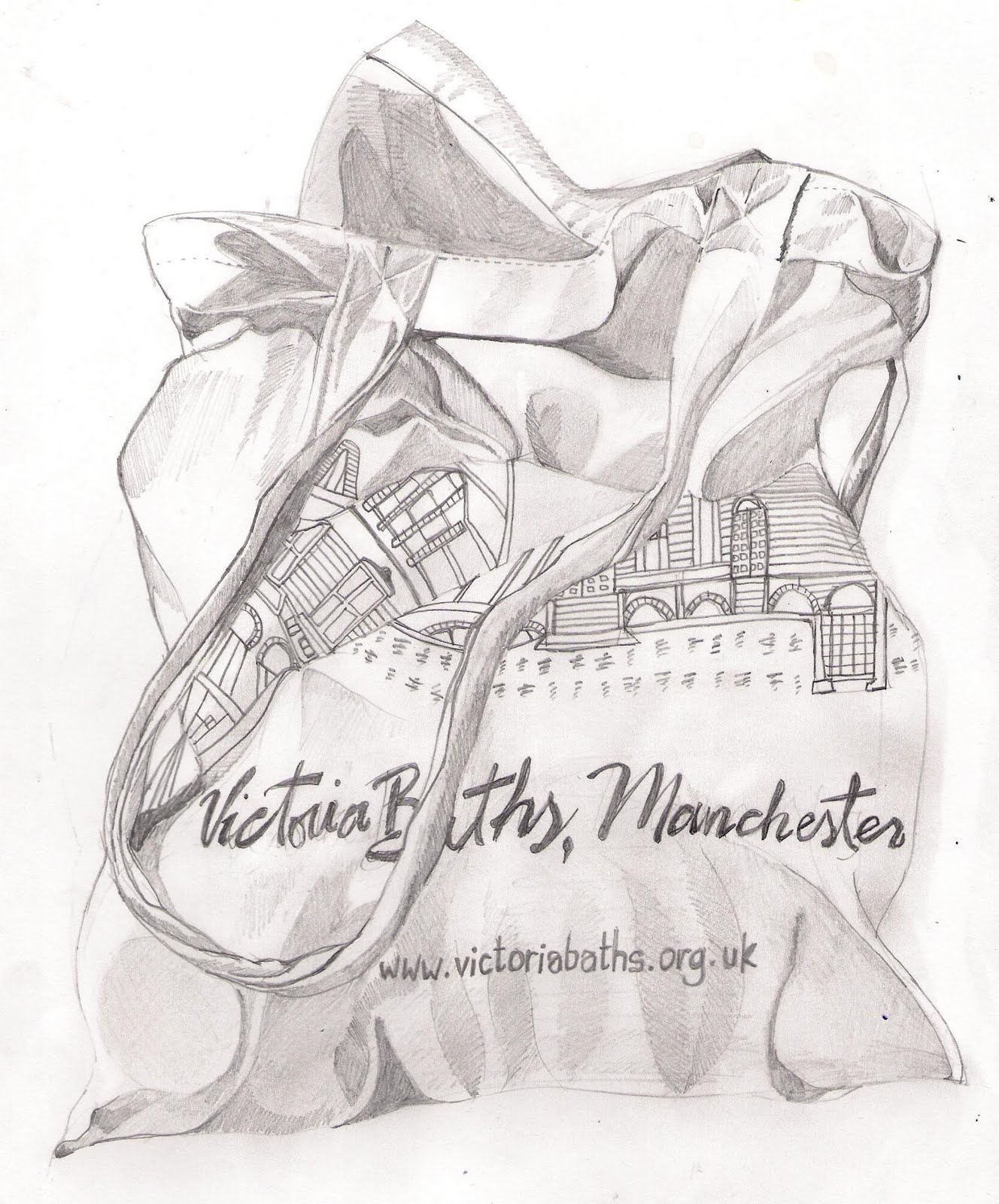
Souvenir


This is an illustration I've done for the Local History Society zine, it's of my Victoria Baths tote bag. I decided that just drawing a bit of a building would be boring, and thinking about Manchester's historical sites, it came to mind that odd souvenirs are often a highlight. Perhaps I will do a souvenir series.

Tuesday, 20 July 2010

Things I have done so far this summer

Last week we had a gig at MRBLHAUS. Here's the flyer I made for it.
Image and video hosting by TinyPic

It was really good, nice people, nice atmosphere. The world is not flat! were magical in our little echoey basement with fairy lights and pom-poms all around. The surprise of the night was the Louche FC who only asked to play at the last minute, everyone was proper into them, they're all fuzzy and 60's http://www.myspace.com/thebicyclethievesuk . All the other bands were brill too, Debbie of The Awkard Turtles/Strums of Indigo, or 'Deorah' on 'ere brought her bags and necklaces and broaches which I would buy had I any money.

After how rad that one was we're probably going to put on more gigs so if you'd like to come and play in MRBLHAUS basement you should ask and if you're good we'll make something happen.

Today I got some lino-cutting things and did a little one of a nice fractal-y leaf that I took a picture of once in a garden centre.
Image and video hosting by TinyPic

Finally, here is an illustrated article on making damson gin that I've done for an upcoming edition of 'The Shrieking Violet'. Of course it has to look good in black and white mainly, but I tried to make it look nice in colour too.

Image and video hosting by TinyPic